
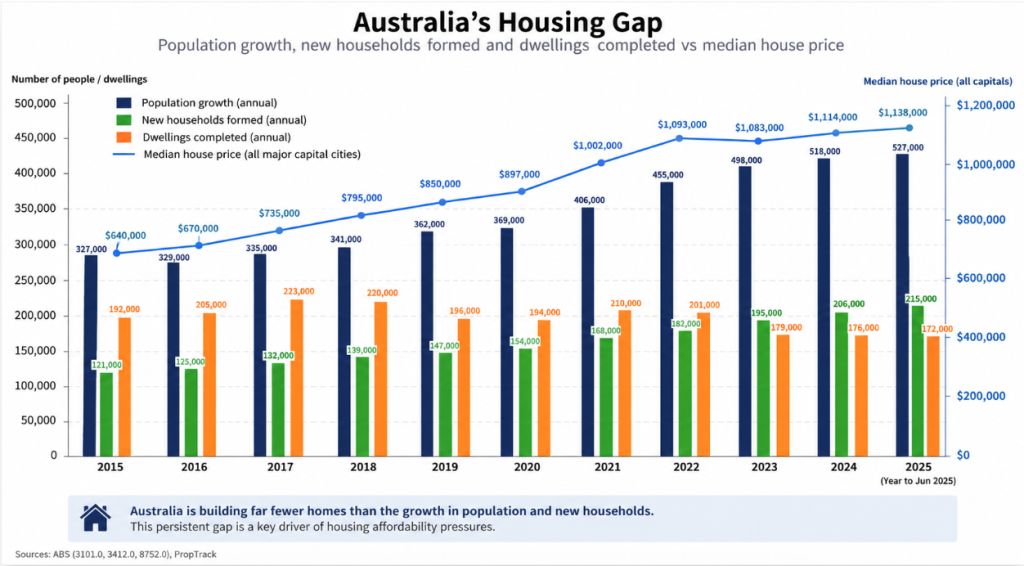
Every so often a chart comes along that says more than a thousand words of commentary ever could. The one doing the rounds on LinkedIn this week — population growth, new household formation and dwelling completions plotted against the median house price across Australia’s capital cities — is one of them.
The story it tells is simple, and it’s been the same story for a decade. In 2015, Australia’s population grew by 327,000 people, forming 121,000 new households, while only 192,000 dwellings were completed. Fast forward to the year to June 2025: population growth had climbed to 527,000, new households to 215,000 — yet dwelling completions had actually fallen to 172,000. Across that same period, the median house price across the major capitals more than tripled, from $640,000 to $1,138,000.
That is not a market malfunction. That is a market doing exactly what markets do when you starve supply and flood demand for a decade straight.
The structural problem nobody wants to own
Australia’s housing shortfall isn’t the product of one villain — greedy developers, foreign buyers, negative gearing, or immigration, depending on who you ask at a dinner party. It’s the product of a planning and approvals system that has been unable to keep pace with population growth for the better part of twenty years, layered with construction sector capacity constraints, rising build costs, and a tax and zoning environment that makes higher-density, well-located housing genuinely difficult to deliver at scale.
Every year the gap between household formation and completions persists, it compounds. You can’t “catch up” on a decade of underbuilding in a single election cycle. The dwellings that weren’t built in 2018 don’t get built retroactively in 2025 — that shortfall simply sits in the price.
When governments meddle, markets usually punish them for it
The temptation, every time affordability becomes a political headline, is for governments to do something. Rent caps. First-home buyer grants. Stamp duty holidays. Foreign buyer surcharges. Windfall taxes on land bankers. Most of these interventions share a common flaw: they treat the symptom (price) rather than the disease (supply), and in doing so they frequently make the underlying problem worse.
Demand-side subsidies — grants, guarantees, concessional stamp duty — tend to get capitalised straight into price, handing the benefit to sellers rather than buyers. Rent controls reliably shrink the pool of available rental stock over time, because they erode the incentive to maintain or add to supply. Punitive taxes on investors can shrink the pool of rental housing without adding a single owner-occupied dwelling to replace it.
None of this means governments should do nothing — planning reform, zoning liberalisation near transport corridors, and genuine investment in trade capacity and prefabrication are all supply-side levers that work. But the political incentive almost always favours the visible, quick-hit demand-side lever over the slow, unglamorous work of approvals reform. That mismatch between what’s popular and what actually works is arguably the single biggest reason this chart looks the way it does.
Prices always revert to the mean — but the mean has moved
It’s worth saying clearly: property markets are cyclical, and cyclical markets revert to the mean. Sydney and Melbourne have both had periods of stagnation or decline lasting several years — 2004 to 2009, and 2017 to 2019 are recent examples. Anyone extrapolating the steep 2020–2025 run in a straight line indefinitely is making the same mistake as anyone who called the top in 2017 and sat out the next five years of gains.
But mean reversion cuts both ways, and it’s important not to misread it. Reversion doesn’t mean prices fall back to where they started — it means growth rates normalise around a long-run trend that is itself a function of population growth, income growth, construction costs and interest rates. Given that three of those four inputs (population, construction cost, and the chronic supply shortfall) are structurally supportive, the long-run trend line itself has likely shifted upward, not just the price sitting temporarily above an old one.
So yes — expect volatility, expect flat years, expect corrections when rates rise sharply. But the structural case for Australian residential property over the long run remains intact, underpinned by a housing shortage that shows no sign of closing before the early 2030s at the earliest, even under optimistic build targets.
What “prudent” actually looks like in this environment
Given all that, blind exposure to “property” as an asset class is not the same as a prudent strategy. A few principles matter more now than they did a decade ago:
Dwelling type matters more than the headline market. Detached houses in supply-constrained, land-scarce middle-ring suburbs have structurally different supply dynamics to high-rise apartments in oversupplied inner-city corridors. Houses and low-rise townhouses on scarce land tend to hold scarcity value; generic high-density apartment stock, particularly where approvals have been generous, is far more exposed to oversupply risk and slower capital growth.
Location discipline is non-negotiable. Proximity to employment hubs, transport infrastructure, and genuine land constraints (geography, heritage overlays, height limits) are the features that protect an asset through a downturn. Growth-corridor land releases on the urban fringe offer affordability but come with none of that scarcity protection — supply can simply keep being released to meet demand.
Ownership structure deserves as much attention as the asset itself. Whether property sits in an individual’s name, a trust, or self-managed super has material implications for tax, asset protection, and intergenerational planning — considerations that compound in value the longer the asset is held. This is genuinely specialist territory, and getting professional structuring advice before purchase, not after, is one of the cheaper insurance policies available to a property investor.
The bottom line
The chart tells a genuinely uncomfortable structural story — Australia has been building materially fewer homes than its population and household formation have demanded, for over a decade, and that gap is the single biggest driver of the affordability crisis dominating the headlines. Governments meddling in the demand side of that equation have, more often than not, made things worse rather than better.
None of that changes the long-run investment case for well-located Australian residential property. It does mean the easy, “just buy anything and wait” version of that thesis is dead. What replaces it is a more disciplined approach — the right dwelling type, in the right location, held in the right structure — for investors willing to think in decades rather than headlines.
This article is general commentary and does not constitute personal financial or investment advice. Readers should seek advice tailored to their individual circumstances before making property investment decisions.