
Australia has a housing supply problem that gets talked about as a planning problem. It isn’t, primarily. It’s a financing problem — and it’s costing us more than most people realise, in a very specific economic form: deadweight loss.The infrastructure financing trap
New housing supply — whether greenfield land release or urban infill — depends on trunk infrastructure going in first: roads, water, power, rail. That infrastructure is expensive, long-lived, and needs financing years before a single lot settles. Australia has essentially two ways to fund it. Governments borrow and build directly, which competes against health, education and every other budget priority, and is constrained by debt appetite and election cycles. Or governments sell a concession to a private operator, who prices the asset to hit an equity-style internal rate of return — often well above what the underlying corridor actually needs to cover its cost of capital.
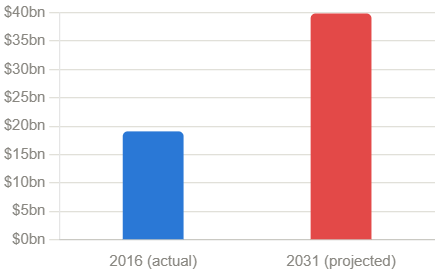
Both paths have a cost. Government financing is slow and politically exposed. Private concession financing is fast but expensive to the end user. And that second cost — expensive-to-use infrastructure — is where deadweight loss enters the picture. Road congestion and public transport crowding cost the Australian economy $19.0 billion in 2016, and without continued investment, that cost was projected to more than double to $39.8 billion by 2031 (source Urban Transport Crowding and Congestion report).
What deadweight loss actually means here
When a toll road, port or utility is priced like a monopolist maximising return rather than like a regulated asset recovering its efficient cost, some users get priced out entirely — even users whose trip, shipment or connection was worth more to them than what it actually costs to provide. That gap between value created and value captured is deadweight loss: a real efficiency cost, not just a distributional one. It shows up as lower usage, lower economic activity along the corridor, and — critically for housing — a higher effective cost of access to the land that infrastructure was meant to unlock.
A new outer-suburban precinct connected by an expensive toll corridor doesn’t function the same way as one connected by an efficiently priced one. Developers pass holding and access costs through to buyers. Buyers factor commute cost into what they’ll pay for land further out. The result is a housing supply curve that’s artificially steeper than it needs to be — not because there isn’t land, and not because there isn’t demand, but because the infrastructure connecting the two is priced to maximise concessionaire return rather than to clear the market efficiently.
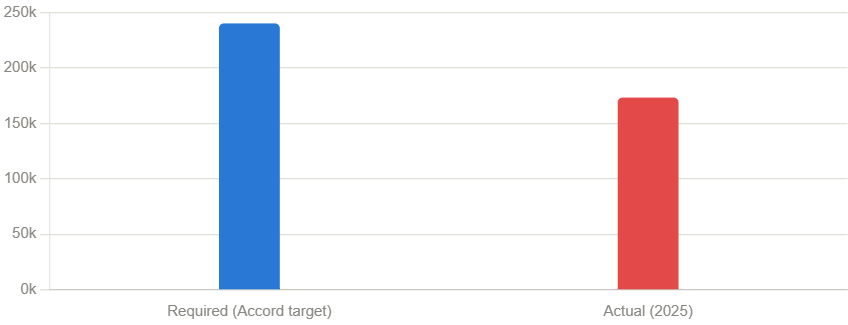
Home Targets vs Actual Builds – Source: Commonwealth Bank newsroom, reporting HIA (Housing Industry Association) figures — about 173,000 homes were completed in 2025, compared with the 240,000 homes a year needed to meet the target.
A structural alternative: the open-ended infrastructure trust
There’s a third model worth taking seriously — a permanent, open-ended infrastructure trust, owned by Australian superannuation funds, with a mandate to earn a bond-like CPI + 3% return rather than to maximise IRR. This isn’t hypothetical: Australian super funds already allocate roughly half their private-market capital to infrastructure, and vehicles like IFM Investors already run super-fund-owned, open-ended infrastructure structures with exactly this long-hold, reinvest-and-recycle approach. What’s missing is a version of this explicitly legislated for public purpose — independent governance, Infrastructure Australia oversight, and a mandate that balances commercial return against affordability and productivity rather than treating those as someone else’s problem.
Why it matters — for investors, wages and housing
The economics of this play out in three separate ways.
For investors: it means Australians’ own retirement savings earn a stable, inflation-hedged, long-duration return matched to what a fund actually needs to pay pensions decades from now — arguably a better fit for that liability than equities or offshore assets, and one that doesn’t rely on speculative capital gains to deliver.
For wage growth: efficiently priced infrastructure is a direct productivity input. Lower effective transport and logistics costs raise the real return to labour and capital across an entire corridor — this is the textbook channel through which infrastructure investment feeds into wages, by lowering the cost of getting people and goods to where the economic activity is.
For housing supply: a trust targeting CPI + 3% rather than a private-equity-style hurdle rate can genuinely charge less to use the infrastructure it builds. That’s not charity — it’s the direct consequence of a lower required return. Recovering even part of that deadweight loss shows up as usable land, faster precinct delivery, and lower embedded holding costs that would otherwise be priced into every new home sold in that corridor.
The design questions that still matter
None of this is a silver bullet. Governance design, asset scope and pricing mandates all need serious scrutiny before a structure like this could work at scale. Who arbitrates when the return target and affordability collide? Does the trust amortise debt and let tolls fall over time, or recycle mature assets into new projects indefinitely? Which asset classes are genuinely suited to a bond-like return profile, and which need a different vehicle entirely? These aren’t footnotes — they’re the difference between a genuinely public-purpose vehicle and a super-fund-friendly infrastructure fund wearing a public-purpose label.
The bottom line
Australia is currently choosing between two financing models that both leave real value on the table — slow, budget-constrained public borrowing on one side, and fast but expensive private concessions on the other. A patient, public-purpose, super-fund-owned trust is a genuine third option, and one that ties the people who need more housing supply directly to the capital that could build the infrastructure to unlock it. That’s not a subsidy. It’s a closed loop — Australians’ own savings, earning a fair return, funding the infrastructure that makes Australians’ own housing more attainable.